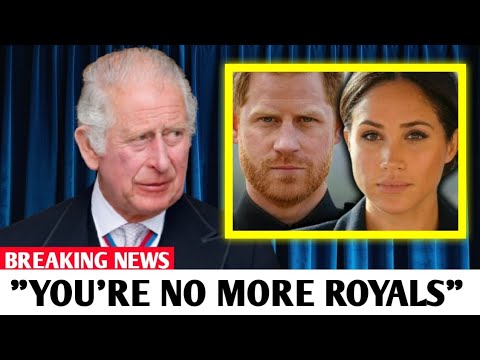
The phrase “You’re no more royal” may be short and blunt—just four words—but it carried an immense weight. These words were not said in public, away from the glare of cameras or the cheers of crowds, but quietly, behind the walls of Windsor Castle, spoken with a voice filled with anger, sorrow, and a sense of finality. Those words shattered the last fragile connection that linked Prince Harry and Meghan Markle to the royal institution that had once defined their entire existence.
Before delving further into this story, it’s worth encouraging viewers to like the video, subscribe to the channel, and activate the notification bell for ongoing updates. The person behind this decisive and painful statement was King Charles III himself. This was no mere symbolic reprimand or a formal statement carefully crafted by palace spokespeople; rather, it was a deeply personal declaration marking a definitive end to a relationship.
For those who have closely followed the Sussexes’ journey over the past few years—from high-profile interviews like the one with Oprah, through memoir revelations, streaming platform deals, and sensational tabloid coverage—it might seem as though all the drama had already been exhausted. Yet, nothing could have truly prepared the world for what had just unfolded. This time, the monarchy did not back down or shy away; the gloves were completely off. Behind closed doors, events have unfolded that shook the very foundations of the British monarchy, reaching from the grandeur of Buckingham Palace all the way to the sunny hills of Montecito, California, where Harry and Meghan reside.
Prince Harry was once beloved by many as a “people’s prince,” a fiery redhead with a rebellious spirit yet a compassionate heart. He carried his mother Princess Diana’s legacy with pride and honor, served bravely in Afghanistan, and was widely admired both by the public and within royal circles. However, somewhere along the way, the relationship between Harry and the institution began to fracture.
It wasn’t simply his decision to marry Meghan Markle, an American actress and activist who didn’t fit the traditional royal mold, nor was it just the relentless media scrutiny and invasive headlines, or the couple’s complex dance of seeking privacy while remaining constantly in the spotlight. The real issue ran deeper. What started as a bold move toward independence quickly descended into public conflict.
Harry and Meghan aired their grievances openly, leveling accusations of racism, neglect, and cruelty against the royal family. Interviews led to documentaries, public statements turned into legal battles, and every explosive revelation made in the public eye seemed to prompt another door slammed shut behind palace walls. Despite this escalating tension, King Charles held onto hope. He was, after all, not just a monarch but a father faced with the almost impossible task of modernizing an ancient institution while preserving its dignity and tradition. He reached out repeatedly, extending offers of reconciliation framed in messages of love and forgiveness, giving them time to heal the wounds. But like power, patience has its limits.
The breaking point was not caused by a single incident but by a series of missteps and perceived betrayals. Trusted palace aides grew weary, viewing the Sussexes’ actions as manipulative. Every time King Charles tried to bridge the gap, Harry and Meghan seemed to prepare yet another public revelation that deepened the rift. From the Oprah interview to the release of Harry’s candid memoir, which not only criticized his brother Prince William but also questioned the very foundations of the monarchy, the pattern was clear.
It wasn’t just about scandals; it was a consistent challenge to the institution’s core. Behind the composed public demeanor, King Charles was deeply wounded, particularly by accusations portraying him as a cold and distant father who was indifferent to his family’s pain. For a man who had spent his whole life preparing to inherit the crown—only to do so after the death of his beloved mother, Queen Elizabeth II—this felt less like betrayal and more like heartbreak.
Then came the moment that tipped the scales. Confidential documents surfaced—financial records, leaked emails, and private communications—that suggested Harry and Meghan had leveraged their royal titles for personal financial gain far beyond what had ever been agreed upon. Contracts hinted at access to privileged royal experiences, private meetings sold to streaming services, and philanthropic efforts that some insiders said were managed more like business ventures than acts of charity.
King Charles had seen enough. It was then that he made the phone call. According to insiders close to the palace, the king personally picked up the phone, bypassing aides and advisors, to confront his son directly. This was a father who had reached his limit. The call lasted less than a dozen minutes but left a permanent mark. Harry, reportedly caught off guard, answered the call while Meghan was nearby, pacing anxiously, phone in hand.
King Charles did not raise his voice or cast blame in an emotional outburst; instead, he calmly and precisely laid out the grievances, recounting every disappointment with a cold, royal resolve. Before ending the call, he spoke the words that would seal the fate of Harry and Meghan within the monarchy: “You’re no more royal.” This was not said out of spite but out of duty. There would be no more royal protection, no honorary titles, and no ties to “the Firm” — the nickname often used for the monarchy itself. The relationship was over.
The fallout was immediate. The palace initially offered no official public statement, but quietly updated the royal website, removing Harry and Meghan’s profiles, trimming their biographies, and taking down their coat of arms. Security was heightened at their Montecito estate amid swirling rumors about their next move—whether they would respond publicly, prepare a rebuttal, or launch another media attack targeting King Charles.
Yet what stunned many was the silence from Harry and Meghan themselves. No immediate social media statements, no spokespeople, no friends issuing comments—only a heavy, resounding stillness that spoke louder than words. Was this the moment they hadn’t anticipated? Was this the final fracture in an already strained family? Some view King Charles’ decision as a grave risk to the monarchy’s public image of compassion and family unity, while others argue it was long overdue to stop the royal institution from being exploited and undermined from within.
This moment was not just about royal protocol; it was about legacy. King Charles may be remembered not only as the monarch who succeeded Queen Elizabeth II but as the father who severed ties with his own blood to protect the crown. The consequences of this decision will ripple for generations. What happens next is only just beginning.
Future revelations will unfold piece by piece—secret letters never seen by the public, confidential royal meetings, Meghan’s last desperate pleas sent just weeks before the final verdict, Prince William’s emotional reactions, Queen Camilla’s private breakdown, and the public’s stunned response. The stripping of titles carries not only symbolic weight but legal, financial, and psychological repercussions. Meanwhile, Harry and Meghan’s American ventures are reportedly unraveling—contracts breaking, endorsements fading, and supporters going silent.
The crown has made its judgment, clear and absolute. The world now wonders: Was this justice or revenge? Was this a king fulfilling his duty or a father turning away? For Harry and Meghan, what remains is a life without palace privileges, without titles, and with no place to return. Only silence, scandal, and shadows linger. When King Charles made that phone call, there were no royal aides present, no advisers whispering suggestions, no media capturing history.
It was simply a father and a son facing a bitter silence that stretched thousands of miles—from Buckingham Palace in London to the sunlit hills of Montecito, California. At first, Charles did not call as a monarch but as a father—wounded and conflicted, who had tried repeatedly over the years to keep his youngest son close despite all the turmoil. He had reached out during birthdays and holidays, through handwritten notes and floral gestures. Yet here they were, two men who once shared a strong bond now separated by a deep and widening chasm filled with public controversy.
When Harry answered, it’s unclear who spoke first. Some say Charles opened with a simple greeting; others say Harry’s voice was already defensive, bracing for confrontation. The atmosphere quickly turned cold. Meghan, reportedly nearby, paced anxiously with the phone in hand, waiting for a sign that the conversation might go their way. But it was not a discussion—it was a verdict. The days leading to that call had been filled with quiet rage, private meetings with legal advisers, consultations with royal communications experts, and even conversations with Prince William. The consensus was clear: Harry and Meghan had crossed the line once too often, and now there would be consequences.
The final breaking point was subtle and personal. It wasn’t a scandal splashed across headlines but a secret deal between the Sussexes and a production company that promised behind-the-scenes access to royal life portrayed through a biased lens. When those documents landed on Charles’s desk, his hands reportedly trembled. Though the contract never used the word “exploit,” to Charles it felt exactly like that—another betrayal, another piece of the monarchy sold for profit disguised as storytelling.
The monarchy depends on trust above all else—that what happens behind palace doors remains confidential, that its members, even in hardship, act for the greater good. When that trust is broken, it’s not only scandalous but threatens the very institution. Thus, the king made the call. What followed was twelve minutes of emotional confrontation. Charles began calmly, laying out each disappointment, every misstep, referencing the interviews, the memoir, the leaked conversations, and the most recent deal that broke the last bonds of trust. Harry listened, sometimes interrupting, as the painful reckoning unfolded.
This dramatic and deeply personal moment has reshaped the monarchy forever, and its impact will continue to echo through royal history.